
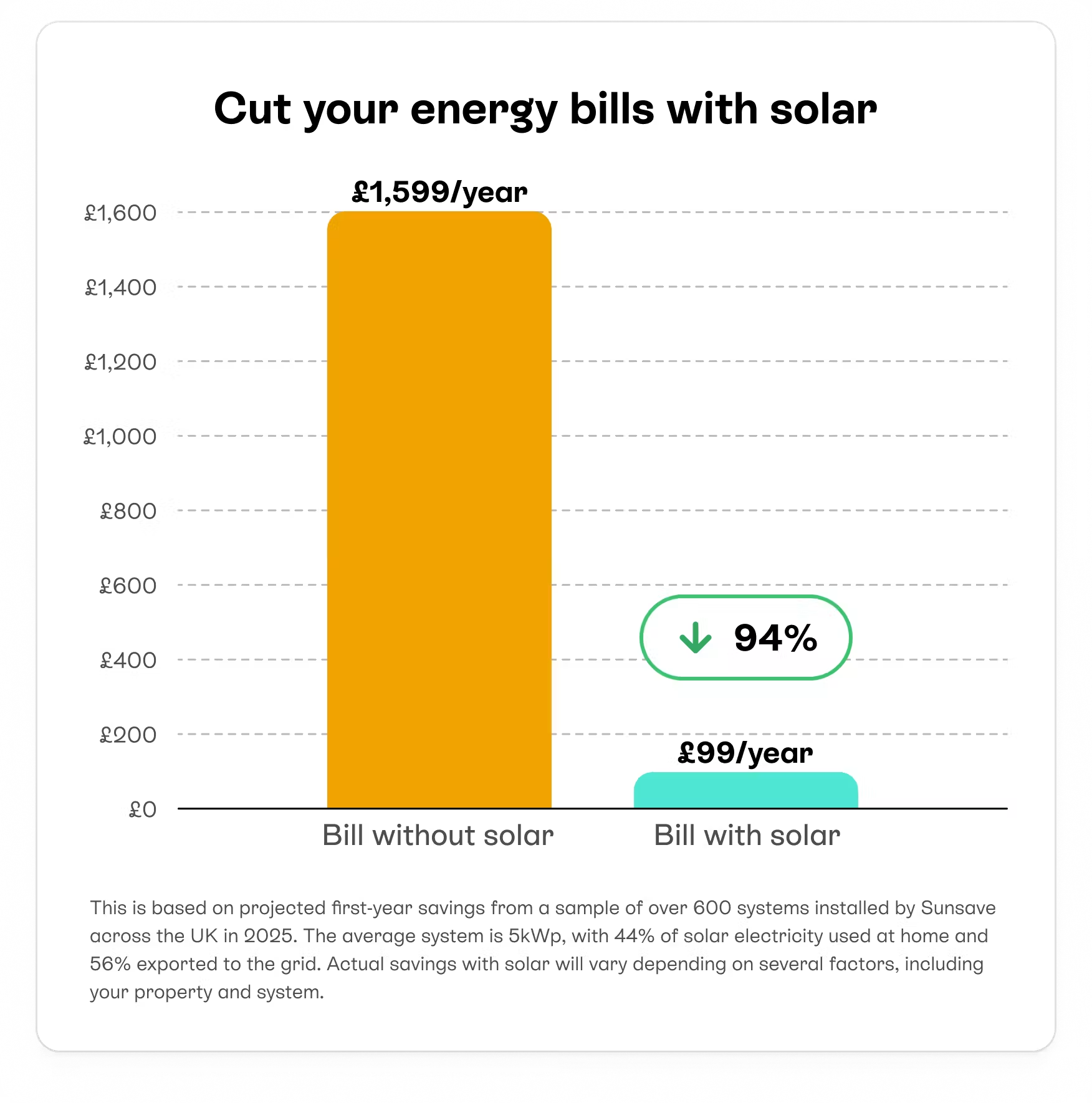
Adding a battery to a solar installation is often marketed around backup power during outages — but it also changes your monthly savings math, sometimes significantly, depending on your utility’s specific rate structure. This guide breaks down what solar-plus-battery actually saves on a typical monthly bill, and the specific situations where a battery meaningfully increases those savings versus situations where it mostly just adds cost for the backup benefit alone.
Solar Alone vs. Solar Plus Battery: The Core Difference
A solar-only system generates electricity during daylight hours. Whatever you use in real time offsets your bill directly; whatever you don’t use gets sent back to the grid, where your utility’s net metering policy determines how much credit you receive for it. At night or during low-production periods, you draw power from the grid as usual, paying your normal rate (or your normal off-peak/on-peak rate, if you’re on a time-of-use plan).
A solar-plus-battery system adds a way to store your excess daytime solar production instead of immediately sending it back to the grid, letting you use that stored energy in the evening or overnight instead of buying grid power at that time. Whether this actually saves you more money each month — beyond the backup power benefit — depends heavily on how your utility structures its rates.
When a Battery Meaningfully Increases Monthly Savings
If your utility has weak or no net metering
In areas where excess solar sent to the grid is credited at a significantly reduced rate (sometimes called “avoided cost” rather than full retail rate), a battery lets you use that excess energy yourself in the evening instead of “selling” it back cheaply and buying it back later at full price. This scenario is where a battery adds the most direct monthly savings on top of solar alone.
If you’re on a time-of-use (TOU) rate plan
If your evening hours (commonly 4-9 PM) are priced significantly higher than your daytime off-peak rate, a battery lets you shift your stored daytime solar energy into that expensive evening window instead of drawing from the grid at peak pricing — directly reducing your highest-cost hours of usage.
If your utility offers a “virtual power plant” or demand response program
Some utilities and battery manufacturers offer programs that pay homeowners a periodic credit or one-time incentive for allowing the utility to draw on their battery’s stored energy during grid stress events — adding an additional, if variable, savings stream beyond your own household’s usage patterns.
When a Battery Adds Less to Your Monthly Savings
If your utility offers full retail-rate net metering
In states or utilities with strong net metering (where excess solar is credited at essentially the same rate you’d pay to buy that electricity), the financial benefit of storing energy yourself versus sending it to the grid and drawing it back later is much smaller — in this scenario, a battery’s main value is backup power during outages, not meaningfully higher monthly bill savings.
If your household’s usage pattern is already well-matched to solar production
Households that use a large share of their electricity during daylight hours (a stay-at-home household, someone who runs the pool pump or does laundry midday) already directly consume a larger share of their solar production in real time, reducing how much excess there is to store or send back in the first place — narrowing the gap between solar-only and solar-plus-battery savings.
A Realistic Monthly Comparison
To illustrate the range, here’s a simplified comparison for an average household with an 8kW solar system and a moderate-capacity battery, across different utility rate structures:
| Scenario | Solar-only monthly savings | Solar-plus-battery monthly savings |
|---|---|---|
| Strong retail-rate net metering | ~$140-$160 | ~$150-$170 (modest additional benefit) |
| Weak/reduced net metering | ~$80-$100 | ~$130-$150 (meaningful additional benefit) |
| Time-of-use plan, wide peak/off-peak gap | ~$100-$120 | ~$150-$180 (significant additional benefit) |
These figures are illustrative estimates based on typical system sizes and usage patterns — your actual numbers depend on your specific system size, local electricity rate, and utility’s exact rate structure, but the pattern holds broadly: the weaker your net metering (or the wider your time-of-use rate spread), the more a battery adds to your monthly savings on top of solar alone.
The Backup Power Value (Beyond Monthly Bill Savings)
It’s worth separating the pure financial calculation above from the practical value of backup power during an outage — a benefit that doesn’t show up as a line item on your monthly bill but is a real consideration for many homeowners, particularly those in areas prone to storms, wildfires, or grid instability. A battery sized to cover essential loads (refrigerator, some lighting, medical equipment, internet) during an outage delivers value that’s difficult to translate into a monthly dollar figure but is often a primary motivation for adding a battery even in a strong net-metering area where the direct financial case is more modest.
How Battery Size Affects the Math
- Smaller batteries (5-10 kWh) typically cover a few hours of essential evening usage or partial outage backup, at a lower added cost (commonly $7,000-$10,000 installed).
- Larger batteries (13-20+ kWh, sometimes multiple units) can cover a fuller evening usage pattern or a longer outage, at a proportionally higher cost (commonly $13,000-$18,000+ installed).
Before choosing a system, compare the available options in our full guide to the best home solar batteries, including usable capacity, power output, warranty, and estimated installed cost.
Bigger isn’t automatically better from a pure savings standpoint — a battery sized well beyond what your daily excess solar production and evening usage pattern actually require doesn’t generate proportionally more monthly savings, since it’s simply not being fully utilized on a typical day. Sizing a battery to your actual usage pattern (available from your utility’s usage history or your solar installer’s production estimates) produces a better financial outcome than defaulting to the largest available unit.
For additional background on residential energy storage and its potential uses, see the U.S. Department of Energy’s Energy Storage overview.
How to Estimate Your Own Solar-Plus-Battery Savings
- Check your utility’s specific net metering policy — full retail rate, reduced/avoided cost, or a time-of-use structure — since this is the single biggest factor in how much a battery adds beyond solar alone.
- Review your household’s usage pattern by time of day, if your smart meter provides this data, to see how much of your usage already happens during daylight hours versus evening/night.
- Ask your solar installer for a battery-specific savings projection, separate from the solar-only estimate, so you can see the incremental value the battery adds to your specific situation rather than a generic combined number.
- Weigh the backup power value separately from the pure financial calculation, since this benefit matters more to some households than others regardless of the monthly dollar difference.
For a starting estimate of your solar investment’s payback period, try our Solar Payback Calculator. Remember that a standard solar payback estimate may not capture the battery’s full incremental cost and savings, so evaluate the battery separately when comparing system options.
Final Thoughts
Whether a battery meaningfully increases your monthly solar savings — or mostly just adds the value of backup power — depends almost entirely on your utility’s net metering and rate structure, not on the battery itself. Households in areas with weak net metering or a steep time-of-use rate spread tend to see the most direct monthly financial benefit from adding a battery, while households with strong retail-rate net metering are often paying primarily for outage protection and grid independence rather than a significantly lower monthly bill. Getting a battery-specific savings estimate from your installer, based on your actual utility’s rate structure, is the only reliable way to know which category your situation falls into.